cal_FR <- create_french_calendar()Appendices
Calendar effect correction
There are two possible procedures for generating calendar regressors: creating customized regressors as shown below, or using predefined regressors in JDemetra+, which also requires defining a reference calendar. Version 3.x of the GUI allows you to automatically [select 🔗)(https://jdemetra-new-documentation.netlify.app/a-sa-pre-treatment#calendar-correction) from the predefined regressor sets, based on statistical tests.
Instead of a simple national calendar 🔗, JDemetra+ allows you to create “chained” 🔗 or “composite” 🔗 with the GUI or rjd3toolkit 🔗.
Creating a reference calendar
To create a French calendar based on French public holidays, you can use the create_french_calendar() 🔗 function from the {rjd3production} package:
This function can be adapted to any national calendar.
Generation of regressor sets
Using the French calendar, it is possible to generate calendar regressors based, for example, on the usual groupings used by INSEE:
regs <- create_insee_regressors(start = c(2000, 1), frequency = 12, length = 360)
sets <- create_insee_regressors_sets(start = c(2000, 1), frequency = 12, length = 240)
names(sets)
[1] "REG1" "REG2" "REG3" "REG5" "REG6" "LY" "REG1_LY"
[8] "REG2_LY" "REG3_LY" "REG5_LY" "REG6_LY"Quality Report: Diagnostics and R Code
Diagnostics selected by default when using X-13-Arima are as follows:
Table A1: Diagnostics
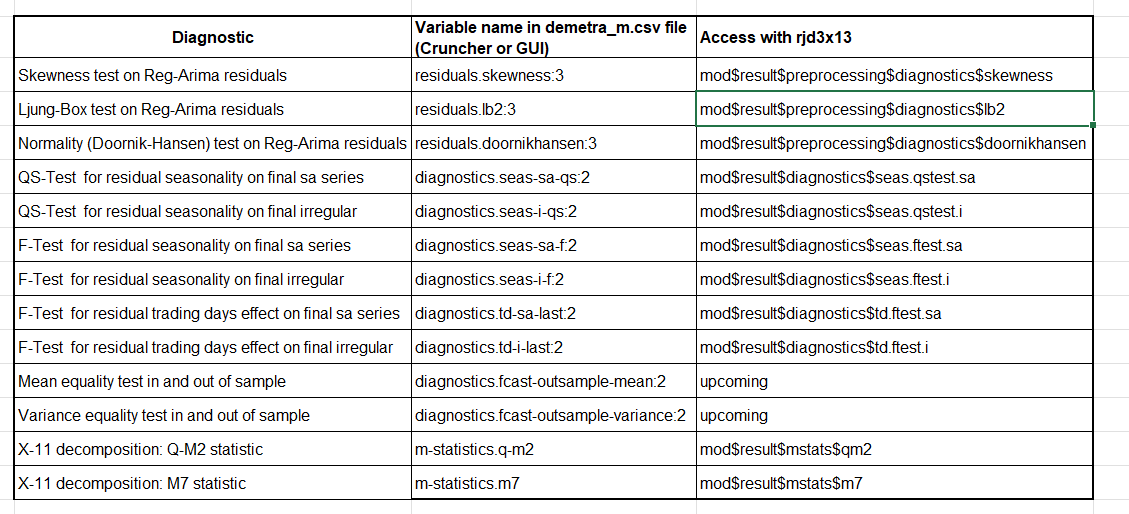
In R, the diagnostics are extracted from the “model” object containing all the estimation results and obtained with the code below.
model <- x13(my_series, my_spec)
str(model)
More information on the tests is available in the documentation 🔗
Score equation
\[ \begin{aligned} score\_total &= 30 * grade\_qs\_residual\_s\_on\_sa\\ &+ 30 * grade\_f\_residual\_s\_on\_sa\\ &+ 30 * grade\_f\_residual\_td\_on\_sa\\ &+ 20 * grade\_f\_residual\_td\_on\_i\\ &+ 20 * grade\_qs\_residual\_sa\_on\_i\\ &+ 20 * grade\_f\_residual\_sa\_on\_i\\ &+ 15 * grade\_oos\_mean\\ &+ 10 * grade\_oos\_mse\\ &+ 15 * grade\_residuals\_independency\\ &+ 5 * grade\_residuals\_skewness\\ &+ 5 * grade\_residuals\_homoskedasticity\\ &+ 5 * grade\_q\_m2\\ &+ 5 * grade\_m7 \end{aligned} \]
Annual campaign: comparison of workspaces
Creation of WS_work
The WS_work is a merger between WS_ref and WS_auto. A score is calculated for both workspaces and, for each series, the SA-Item is retrieved from the workspace with the lowest score between WS_auto and WS_ref.
In an annual campaign process, we will use the transfer_sa_item() 🔗 function from {rjd3workspace} to merge WS_ref and WS_auto.
# save WS_ref as initial version of WS_work
WS_auto <- load_workspace(file = "./WS/WS_auto.xml")
WS_work <- load_workspace(file = "./WS/WS_work.xml")

sap1_auto <- .jws_sap(jws = WS_auto, idx = 1)
sap1_work <- .jws_sap(jws = WS_work, idx = 1)

# update ws_work with sa-items from ws auto when necessary
transfer_series(
    jsap_from = sap1_auto,
    jsap_to = sap1_work,
    selected_sa_items = c("RF0610", "RF0620")
)

save_workspace(jws = WS_work, file = "./WS/WS_work.xml")
Refreshing data in R data
In version 3 of JDemetra+, refresh policies can also be applied directly in R and no longer only via the GUI or the cruncher, as was the case in version 2.
TS Objects
In the object (list of lists) containing the estimation results in R, you can extract the estimationSpec and resultSpec (or pointSpec) The refresh policy will allow you to remove certain constraints in the estimationSpec, in the example below to re-identify outliers from January 1, 2017.
library("rjd3x13")
# estimate a model
sa_x13_v3 <- rjd3x13::x13(y_raw, spec = "RSA5")
current_result_spec <- sa_x13_v3$result_spec
current_domain_spec <- sa_x13_v3$estimation_spec

# generate NEW spec for refresh
refreshed_spec <- x13_refresh(
    current_result_spec, # point spec to be refreshed
    current_domain_spec, # domain spec (set of constraints)
    policy = "Outliers",
    period = 12, # monthly series
    start = "2017-01-01",
    end = NULL
)

# apply the new spec on new data : for example y_new= y_raw + 1 month
sa_x13_v3_refresh <- x13(y_new, refreshed_spec)
Workspaces
It is possible to refresh a workspace or SA-Processing without using either the Cruncher or the GUI with the jsap_refresh() and jws_refresh() functions from the rjd3workspace package.
ws <- jws_open(file = ws_path)
jws_refresh(jws = ws, policy = "lastoutliers")
save_workspace(jws = ws, file = ws_path)
Additional information on specifications
Modification
domainSpec(or Reference Specification)
Modification in the GUI:

Using this same menu, you can apply the Reference Specification or the Result Specification to a series.
En R :
library("rjd3workspace")
set_domain_specification(jsap, 1L, new_domain_spec)
estimationSpec
Modification in GUI:

In R :
library("rjd3workspace")
set_specification(jsap, 1L, new_estimation_spec)pointSpec(or Result Specification)
Estimation result can be applied as indicated above.
library("rjd3workspace")

jws_compute(jws)
read_workspace(jws, compute = TRUE)
read_sap(jsap)
read_sai(jsai)
Refresh policy behavior
The estimation is made using the latest estimationSpec, but a refresh policy aims to remove all or part of the constraints of the estimationSpec and return to the domainSpec.
The “concurrent” policy returns to the
domainSpecby deleting user-defined parameters not written in the domain spec (difference in behavior compared to version 2 of JDemetra+: changes made via the specification window on the right are deleted).“concurrent” refresh deletes the outliers pre-specified in the
estimationSpec(for example, in the GUI via the specification window on the right), which corresponds to a modification of theestimationSpec; all outliers will be re-identifiedRefresh “lastoutliers” deletes the outliers pre-specified in the
estimationSpecover the last year (or other defined span), and a re-identification will be performed over this period.
This allows the user to differentiate between permanent settings (domainSpec) and temporary settings (estimationSpec).
Example
Here is a common procedure for updating data in the case of a sub-annual campaign with output generation using the cruncher. Please note that you must save the workspace before performing a “refresh.”
New raw data is available (new points and revision of the recent past).
Use a “refresh last outliers” to benefit from automatic detection
Check the results and revisions, and for certain important series, review the automatic detection
Open the graphical user interface and modify the
estimationSpecof a series via the window on the right by adding an outlier \(Out_1\) in the last yearApply and save these changes in the GUI
Regenerate an output with the cruncher (export the final series)
If policy = lastoutliers again: return to the
domainSpecfor the last year, \(Out_1\) is lostIf you want to keep \(Out_1\), use the option policy = “arimaparameters”; the identification does not change, only the coefficients are re-estimated
To keep \(Out_1\) and re-identify with ‘lastoutliers’ again, you must write \(Out_1\) in the
domainSpec(called “reference specification” in the graphical interface)
Differences between version 2 and version 3
In JDemetra+ version 2.x, there is no estimationSpec. The settings set by the user are therefore necessarily in the domainSpec and are therefore never deleted by a refresh policy.
Workspaces created in version 2 can be opened in version 3, but it will no longer be possible to return to version 2.
Copying specifications when a version 2 workspace is opened in version 3:
domainSpeccopied todomainSpecandestimationSpecpointSpectopointSpec
Data structures
Workspaces are organized into SA-Processing and SA-Item.
SA-Processing
An SA-Processing (SAP) is represented by an .xml file. It contains SA-Items and user-defined reference specifications.
SA-Item
An SA-Item contains information about a given series:
raw data
specifications (
pointSpec,estimationSpec,domainSpec)metadata
Metadata
The metadata (see the .xml file corresponding to SA-Processing) contains:
the type of source of the raw data
the “id” of the file containing the raw data (path and parameters) that will be used to refresh the estimate
any comments on the series (generally used to justify a choice of parameters)
Modelling context
The modelling context contains the calendars, variables, and external regressors needed for the estimates made in the workspace.
Migration to JDemetra+
It is possible to convert X-13 specifications used in the US Census Bureau’s X-13-Arima-Seats software into JDemetra+ X13-Arima specifications.
This operation is performed using the graphical interface with the SpecParser 🔗 plug-in, which can only be used in version 2. The workspace containing these specifications can be opened in version 3. The plug-in documentation can be found here 🔗 and all the migration steps are described here 🔗 in the JDemetra+ documentation.